“Invasive” plants are non-native species that have spread into native or minimally managed plant systems in Massachusetts. These plants cause economic or environmental harm by developing self-sustaining populations and becoming dominant and/or disruptive to those systems. As defined here, “species” includes all synonyms, subspecies, varieties, forms, and cultivars of that species unless proven otherwise by a process of scientific evaluation.

Garlic Mustard
Garlic mustard (Alliaria petiolata) is an invasive biennial weed. This article displays images to assist with identification and provides recommendations for control, including a management calendar and treatment and timing table. Background Garlic mustard (Alliaria petiolata) is an herbaceous member of the mustard family (Brassicaceae) brought over by early European colonizers. First documented in New…


Oriental Bittersweet
Background Oriental bittersweet (Celastrus orbiculatus) was introduced to the United States in the 1860s from east Asia. This woody, deciduous, perennial vine has since naturalized and become an extremely aggressive and damaging invader of natural areas. Oriental bittersweet chokes out desirable native plants by smothering them with its dense foliage and strangling stems and trunks.…
Autumn Olive
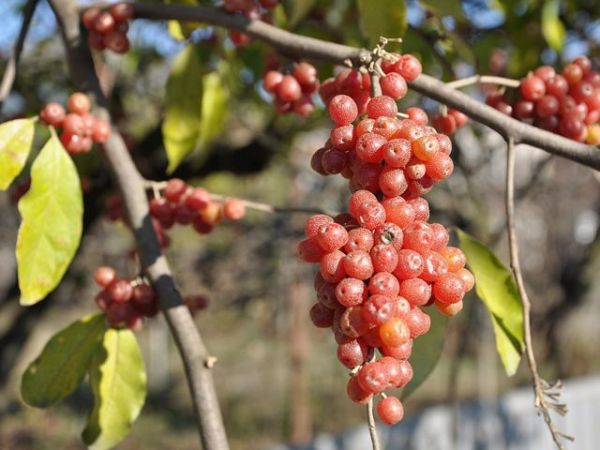
Autumn olive trees were planted for soil erosion. But its prolific fruit and seeds have disrupted native ecosystems. Scientific Name: Elaeagnus umbellata Introduction: Brought to U.S. from Asia in 1800s, planted widely in 1950s for erosion control. Identification: Grayish green leaves with silvery scales bottom side, gives off shimmery look. Stems are speckled, often with…
Black Locust

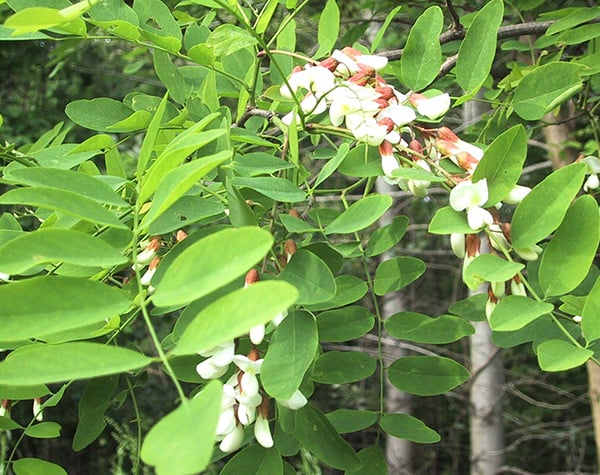
A deciduous tree, black locust (Robinia pseudoacacia) was brought here from the Appalachian and Ozark Mountains for erosion control and durable wood. It has white flowers and compound leaves, and the saplings and smaller branches of mature trees have thorns. It can grow up to 100 feet high.
It invades fields, grasslands, and open woodlands. It can increase soil nitrogen levels, which threatens native plants that are adapted to nitrogen-poor soils.
Controlling Black Locust
Cutting alone is generally not effective at controlling this plant, because of prolific stump sprouting and root suckering (when trees sprout from an existing tree’s roots). Systemic herbicides can be effective when applied to the freshly cut stumps, but you may need to monitor and re-treat in subsequent years. Always read and follow the directions on the label when using herbicide. In fields, regular mowing can control root suckers.
Common Buckthorn
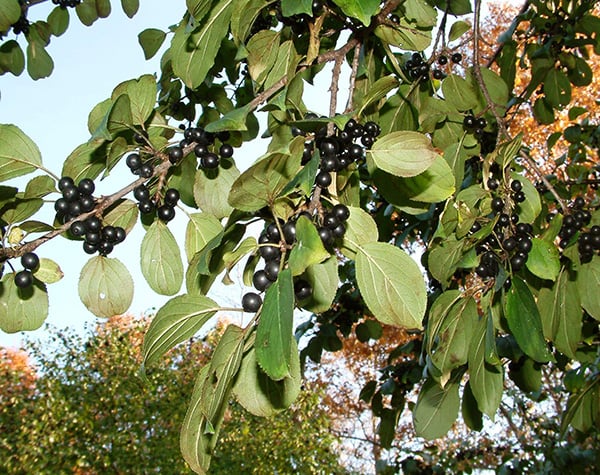
Common buckthorn (Rhamnus cathartica) is a deciduous plant with oval-shaped leaves and small dark fruit. It grows as a shrub or a small tree up to 20 feet tall. It’s originally from Europe and Asia, and it is sometimes used for landscaping and hedges.
It produces high numbers of fruits, which are dispersed by birds. It invades fields and field edges, forming dense stands that exclude other plants.
Controling Common Buckthorn
For seedlings and small saplings, hand pulling or repeated cutting or mowing can work well. For larger plants, cutting followed by treating of the freshly-cut stump with a systemic herbicide is generally effective. Another option is cutting followed by the application of a foliar spray of a systemic herbicide to the new growth that sprouts from the stump. Always read and follow the directions on the label when using herbicide.
Glossy Buckthorn

With shiny leaves and small dark fruit, glossy buckthorn grows as a deciduous shrub or a small tree up to 20 feet tall.
With shiny leaves and small dark fruit, glossy buckthorn (Frangula alnus) grows as a deciduous shrub or a small tree up to 20 feet tall. Native to Europe, Central Asia, and North Africa, it may have been introduced for landscaping.
It produces many fruits, which are spread by birds, and invades fields, field edges, woodlands and wetlands, crowding out other plants.
Controlling Glossy Buckthorn
For small populations of seedlings and small plants, hand pulling can be effective. In fields, try frequent mowing. For larger plants, cutting can work well; either immediately apply a systemic herbicide to the cut stems, or apply it as a foliar spray to stump sprouts the following year. This plant frequently grows in wetlands subject to the Massachusetts Wetlands Protection Act. Anyone planning control work in these areas should first check with the local conservation commission; only herbicides registered for use in wetlands should be applied. Always read and follow the directions on the label when using herbicide.

Common barberry (Berberis vulgaris) is an upright shrub from Europe that grows to 10 feet tall, although most plants are less than 6 feet tall. It has distinctive three-part thorns, produces hanging clusters of yellow flowers in May and June, and red fruits in late summer and fall.
Common barberry produces large numbers of fruit that are eaten by birds, which then spread the seeds across the landscape. Common barberry invades fields, forests, and wetland edges. It was widely eradicated in the late 19th and early 20th centuries but persists and remains a threat.
Controlling Common Barberry
Small plants can be hand pulled. Thick gloves are needed when working with barberry due to the presence of numerous sharp spines. Systemic herbicides are effective when applied as a foliar spray or to freshly cut stumps. Barberry may be found growing in wetland areas subject to the Massachusetts Wetlands Protection Act. Anyone planning control work in wetland areas should first check with the conservation commission of the community where the work will be performed. Always read and follow the directions on the label when using herbicide. In wetlands, only herbicides registered for use in wetlands should be used.
 WETLANDS TRAILS WALKING